Every month your body does something quietly extraordinary: it builds a warm, blood-rich place for a life to begin, holds it ready, and — when none comes — lets it go and begins again. It is the same work women's bodies have done for thousands of years — and yours will go on doing it for decades.
These are not separate events, but one loop, turning. Once you can see the shape of it, the tiredness, the lift, the cravings, the calm stop being random — each one belongs to a place on the wheel. Here is the whole turn of it.
A full cycle runs from the first day of one period to the first day of the next.
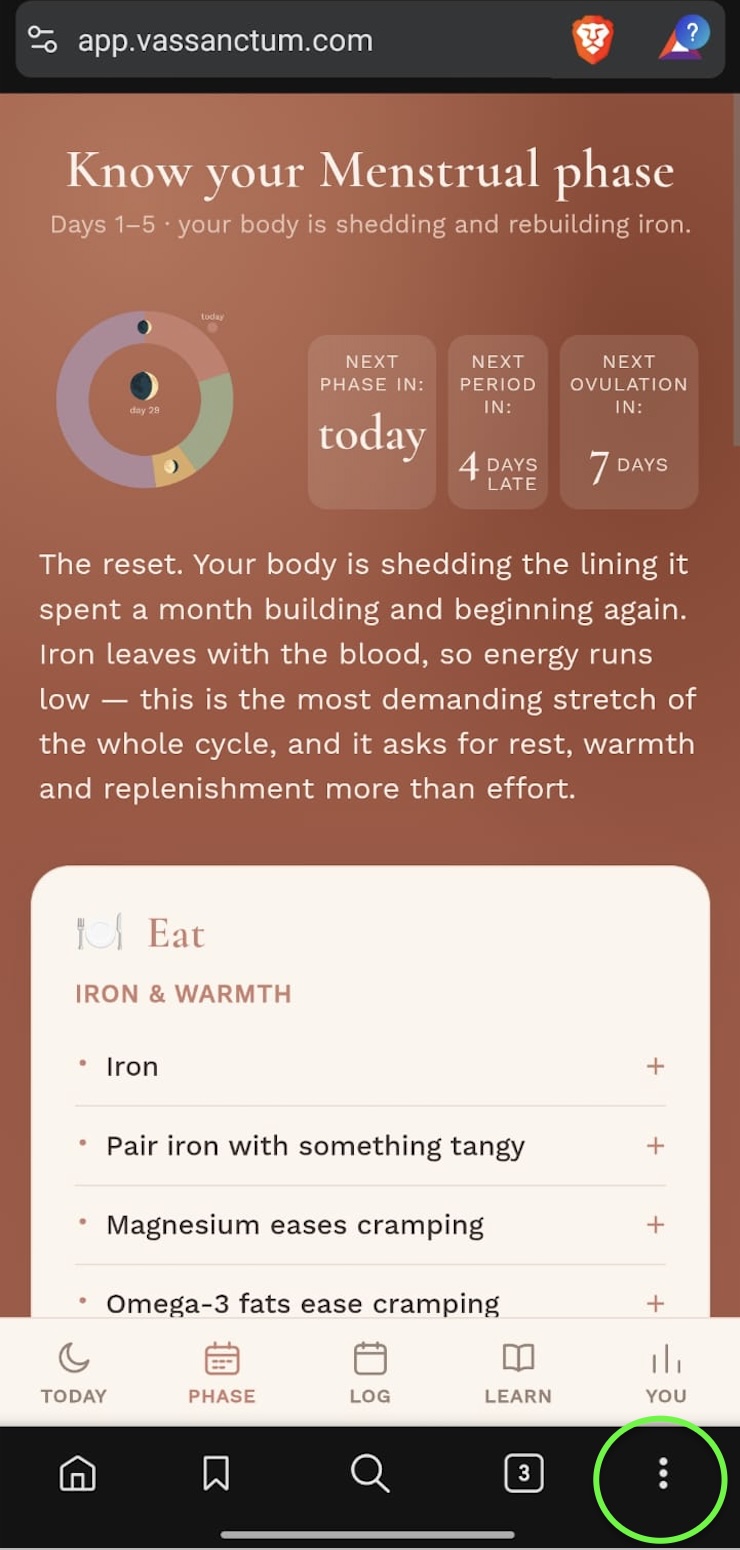
It begins with the bleed — which sounds like an ending, but day one of bleeding is day one of the whole cycle. Two hormones run the whole loop: estrogen, the builder, and progesterone, the calmer.
This is the lowest point of the month — both of them near the floor, the lining your body spent weeks building now releasing, and iron leaving with the blood. That last part matters — iron carries oxygen around the body, so when it drops, your energy drops with it.
For most of human history this was the quiet stretch, the body built for repair rather than for hunting or hard work. So the heaviness, the pull to slow down, the wish to do less are not you failing to keep up.
They are the oldest maintenance setting you have, running exactly on time.
As the bleed ends, estrogen begins to climb, rebuilding the lining and ripening the next egg. Underneath, several tiny follicles — fluid-filled sacs, each holding an egg — start growing in a quiet race, until one pulls ahead and the rest step back.
As estrogen rises it carries everything up with it: energy, mood, focus, even how sharp your memory feels. The body also adapts faster now than almost any other time, with muscle, skin, and stamina all responding more readily.
This is its strongest window to build, to begin, to push. These are the days our ancestors would have spent roaming further, learning fast, starting things. So if the world feels more possible this week, more within reach, that is not a mood you have to distrust.
It is real chemistry lifting you — and it is yours to use.
Then, around the middle of the cycle, the body sends one sharp hormonal signal and the ripened egg is released — the single fertile stretch of the whole month. For a day or two everything peaks at once: energy, confidence, desire, coordination, and a small lift of testosterone adding extra drive.
Women make testosterone too, in much smaller amounts than men, and it rises right at this peak. None of that is accidental — the body raises desire and draws you outward exactly when conception is possible. This was the body at its most outward by design, the few days when being quick and social and magnetic mattered most.
So feeling most like yourself, turned all the way up, is not vanity or an accident. It is exactly what this short window is for.
With ovulation, the egg slips into the fallopian tube, where for a day or so it can still meet a sperm and be fertilised. Whether or not that happens, the body now commits — fully — to the possibility of a pregnancy.
That waiting is the luteal phase, the longest stretch of the cycle. The empty follicle the egg left behind does not simply close over and disappear. It becomes a small gland of its own, producing progesterone — and for two weeks the whole phase rises, holds, and falls with that hormone, moving through three distinct moods.
Early luteal
Progesterone climbs, and its first effect is steadying — sleep comes easier and mood holds. It also turns up the body's inner thermostat, so your temperature sits about half a degree higher for the rest of the cycle. That faint, steady warmth is the body keeping the nest warm, in case a fertilised egg arrives to grow there.
For a few days this is often the calmest the body feels all month. The bright outward energy of ovulation begins, quietly, to turn inward.
Peak luteal
Progesterone reaches its peak, and the body shifts into provisioning — quietly stocking up on energy in case a pregnancy now needs feeding. That is why appetite climbs and metabolism rises a little to match. The cravings that arrive now are driven by hormones, not a failure of willpower. It is an old instinct to gather and store, readying the body for a pregnancy whether or not conception happens.
Late luteal
Then, near the end, if no pregnancy has begun, there is no longer anything to prepare for. Everything since ovulation — the warmth, the provisioning, the steady calm — was the body readying itself for a baby that has not come.
So it lets the effort go. The small gland that was making progesterone lives only about two weeks unless a pregnancy signals it to carry on, and with no signal, it breaks down. Both hormones fall together, and that steep drop is the PMS window.
What most people call PMS — the irritability, the broken sleep, the easy tears, the wish to do less — is a real chemical withdrawal, running on a fixed schedule. It is not a flaw in your character, and it lifts when the bleed comes.
And there you are, back at day one — the lining releasing, the body beginning the whole quiet construction over again. Not a fault to be fixed. A rhythm to be known.